Showing posts with label travel. Show all posts

Friday, October 9, 2015

Event Report: Wimberley Village Library 'Lunch & Learn'

It is kind of fun to talk about one of my books and the research I did for it in the heart of the area it is about! On Wednesday, October 7, I had the pleasure of giving a "lunch and learn" presentation on my just-released Ghosthunting San Antonio, Austin, and Texas Hill Country to a couple dozen people at Wimberley VillageLibrary in Wimberley, Texas. 

Suffice it to say that my one-hour lecture, PowerPoint presentation, and question-and-answer session went very well. Several attendees asked great questions and about half the people came were engaged enough by the subject that they decided to pick up a copy of the new book. 

Thanks very much to everyone who came to this event and to Sarah Davis, the library assistant for circulation and programs, for setting it up! This was my first presentation in historic and haunted Wimberley and I certainly hope it won't be my last. 


Tuesday, September 29, 2015

Our Haunted Hill Country

Of the three title areas I cover in my just-released travel guide, Ghosthunting San Antonio, Austin, and Texas Hill Country, the last is undoubtedly my favorite for a number of reasons, one being because it is where I live. This 25-county area is full of historic towns and villages, wilderness areas, lots of ranchland surrounded by fences hung with unwelcoming signage — and numerous haunted places. Following are a handful of my favorites, all of them publicly accessible. 

The Devil's Backbone, aka Ranch-to-Market Road 32, is a haunted highway that corresponds to a ridgeline used by Spanish explorers travelling inland and later by ranchers driving cattle. Parts of this road seem mysterious and haunted under the best of conditions and it is little wonder that it should have so much ghostly lore associated with it, to include an ominous "White Lady" that causes car wrecks. One spot along the highway travelers might want to visit is the Devil's Backbone Tavern, a haunted watering hole located on the site of an old Indian campground and what was once a stagecoach stop. 

Enchanted Rock State Natural Area has been part of the Texas state park system was designated as a Recorded Texas Historic Landmark in 1936. Native Americans believed the site was a portal to the otherworld and there are countless legends, ghost stories, and paranormal phenomena associated with this wondrous natural site, whose name is not arbitrary or just meant to be colorful. 

Jacob's Well is an artesian spring located just north of Wimberley. Peering into the mysterious and ominously beautiful depths of Jacob's Well, it is almost hard to believe that it is not haunted. Native Indians certainly held this natural artesian spring, which rises up through a limestone tube from the unmeasured depths of the underworld, to be sacred and inhabited by elemental spirits of the land. Beyond its appearance and hallowed nature, however, it is also the site of numerous drownings and there are those who believe the ghosts of those who have perished at this spot continue to haunt it.

James Kiehl River Bend Park is a pleasant recreational area situated along the banks of the Guadalupe River. Paranormal phenomena like strange mists, orbs, and EVPs have been noted both at it and a disused SA&AP railway bridge located nearby. There are also four small cemeteries dating at least as far back as the 1800s in the vicinity of the park.

The Treue Der Union Monument in the historic village of Comfort marks one of the strangest, bloodiest, and most heartbreaking episodes in the saga of a violent state, the Nueces Massacre, which took place during the Civil War. There is every reason to think the "Loyalty to the Union" monument might be haunted by the spirits of those whose deaths it memorializes and whose remains it marks.

Wimberley started as a trading post near Cypress Creek in 1848, the year Hays County was organized, and its original gristmill was expanded over the years to process lumber, shingles, flour, molasses, and cotton. The mill was shut down in 1925 but the community has continued to grow in more recent times into a resort town and destination for tourists and ghosthunters alike. Virtually every historic building in the town is reputed to be haunted and late author Bert Wall wrote numerous books specifically about the ghosts and legends of Wimberley and the surrounding area.

Other Hill Country sites with haunted lore associated with them include Fort Martin Scott in Fredericksburg, the Kerr County Courthouse in Kerrville, the Lover's Leap overlook outside of Junction, Schreiner University (notably its Delaney Hall), and the Y.O. Ranch Hotel & Conference Center. There are many more beyond these and if you ask the staff at any two establishments in historic communities in this area chances are at least one of them will have a ghost story associated with it.

And anyone who wants to learn more about haunted places in our area can find my book in stores and at sites like Amazon.com and can follow my Ghosthunting San Antonio, Austin, and Texas Hill Country Blog!

I wrote the above article for the West Comal County Chronicle, a publication I write for off and on that is published by the Bulverde/Spring Branch Library, at which I periodically do educational lectures. 


Sunday, August 9, 2015

My Favorite Haunted Road Trip Project

Periodically someone will ask me what my most and least favorite book projects have been and the answer to both questions is the same: my most recent one.

As contradictory as that might sound it is very true. My latest project is inevitably the one I have been most excited about and engaged with recently, for which the endorphin rushes received from finishing the various elements are most immediate, for which any exciting fieldwork I did is most memorable. That project is also the one for which I have suffered the most recent stress, for which I can most acutely feel physical rigors like lost sleep, for which other things have suffered because of my disproportionate use of time and other resources. This is the strange dichotomy of book authorship.

Its immediacy aside, I can nonetheless say that, of all the projects I have worked on for the America's Haunted Road Trip series of travel guides, Ghosthunting San Antonio, Austin, and Texas Hill Country has definitely been my overall favorite. This is true for a variety of reasons.

One is my love for the American Southwest of which Texas is a part and the unique, violent, and colorful history that makes it such a fun subject for research, writing, and roadtrips and a likely locale for haunted places. Good subject matter counts for a lot.

Another reason is the almost iconic distinctness of the places I selected for inclusion in this book, which include everything from wilderness areas that have existed for time immemorial to ancient missions, grand hotels, and great public buildings. This variety of locales made the book stimulating to work on and that is the sort of thing that translates into a into a more enjoyable experience for readers.

Finally, a big reason is the improvements we have made in the format of this book so that it would be even more useful resource for the people using it as a guide on their own haunted road trips. Foremost among these improvements is a robust section of Additional Haunted Sites, which contains entries on 60 locations and effectively triples the number of places covered in earlier books in the series.

All these things have made not just me feel good about what I have accomplished with Ghosthunting San Antonio, Austin, and Texas Hill Country — they have also made me very confident that the effort I have put into it will make it a valued resource for readers and one of their favorite volumes in the series as well. 

Monday, December 29, 2014

Texas Capitol (Downtown Austin)

"Few if any places in a particular state are cauldrons of so many conflicting passions, beliefs, and motivations as their capitol buildings and there is not one that has not over the years acquired a reputation for being haunted. It should thus hardly be surprising that the capitol of a state that has historically been so marked by violence, corruption, and zealous ideologies as Texas should have a wealth of ghostly lore and strange phenomena associated with it. 

'The capitol is haunted day and night,' Fiona Broome, a psychic, ghost hunter, and author of The Ghosts of Austin, Texas said in a 2008 interview. 'If you've got a nice, misty day there, people see ghosts walking up the path to the capitol building all the time.'" 

Those are the first two paragraphs of my chapter on the Texas Capitol for the Austin section of Ghosthunting San Antonio, Austin, and Texas Hill Country! Below left, the statue of David Crockett in the south foyer of the capitol building with the rotunda in the background; below center, the floor of the rotunda, a whispering chamber where the spirits of workers killed during construction are sometimes seen; below right, the domed ceiling of the rotunda more than 300 feet above. 


Wednesday, December 17, 2014

The Driskill (Downtown Austin)

"There is a lot to recommend the Driskill hotel and any number of things that might make it appealing to visitors. It is the oldest operating hotel in the state capital of Texas, is steeped in history, has any number of colorful stories associated with it, and is beautiful and luxurious. As one might expect from its inclusion here, of course, it is also widely reputed to be haunted, and the hotel does nothing to discourage this belief. 

When my wife and I visited the hotel and had brunch in its 1886 Cafe and Bakery one Sunday in November 2014, in fact, and I asked our waiter if the property was haunted, he immediately responded that he believed it was. He then also went and got us a couple of handouts provided by the hotel, one that listed some of the hauntings associated with it and another that described its mundane history.

Those are the first two paragraphs of my chapter on the Driskill hotel for Ghosthunting San Antonio, Austin, and Texas Hill CountryOne person who went on the record about their supernatural experiences at the Driskill was Johnette Napolitano, lead singer for the alternative rock band Concrete Blonde, who commemorated her encounter in the 1992 song "Ghost of a Texas Ladies' Man." 


Wednesday, December 10, 2014

Richard Moya Park (Southeast Austin)

"To those uninterested in or oblivious to the paranormal, Richard Moya Park, a wooded tract of land along the banks of Onion Creek, is best known for its bridge, which consists of three black-iron spans that were once located in downtown Austin. Initially constructed at a cost of $45,000, it served as a toll bridge for just two-and-and-half years, until June 18, 1886, when it was closed and then removed to make way for a wider span. The history of the bridge is briefly described on a Texas Historic Landmark marker erected at its south end in 1980 ... 

... What the marker does not say is that the bridge itself is believed by many to be haunted and has been the subject of numerous ghostly tales over the past century, most of which allude to an ill-fated romance that ended in violent death. Many visitors to this Blackland Prairie site, especially those who have actually walked across the bridge, have also reported seeing apparitions of various sorts. For what it is worth, the site in Austin where the bridge used to be located has no accounts of paranormal phenomena whatsoever associated with it as far as I am able to ascertain (it is, however, noted for being home to about 250,000 bats and for having one of the most impressive twilight emergences in the country.)" 

Those are the first two paragraphs of my chapter on Richard Moya Park for Ghosthunting San Antonio, Austin, and Texas Hill Country! Between them appears the text from the historical marker at the site, as shown below left; below right, a view of rain-swollen Onion Creek; below center, one of the ponds formed by recent flooding at the site; bottom left, a friendly lizard that is not the worst thing I have ever encountered in a public restroom; bottom right, the back entrance to Richard Moya Park from Moore's Bridge Road and a possible means for investigating the bridge at night despite the park being closed during hours of darkness. 


Monday, December 8, 2014

The Mansion (Boerne/Kendall County)

"Sometime around 1870, a French architect named Frank LaMotte constructed the impressive limestone building on Main Street in the town of Boerne that has since been known in the local area simply as the Mansion. This tradition is reflected in the name of the restaurant, La Mansion, that is located in it today. And just as its name has been carried down through the years, so too have the stories of spiritual activity in the house and a persistent reputation for being haunted, even as it has been passed to different owners and used for a variety of purposes.
  ...
... La Mansion certainly bears visiting by anyone interested in the paranormal, whether they would like to conduct a formal investigation or just have a meal in a place where spirits are firmly believed by many to be present. As I have found in any number of places I have visited and written about over the years, whether the stories about them are true actually has very little to do with whether or not they are really haunted." 

Those are the first and last paragraphs of my chapter on the historic building in Boerne known as the Mansion! Today it houses a notably good Mexican restaurant but is no less haunted than it ever was. Above right, La Mansion as it appears from Main Street; above left, entrance to the building's cellar, where Fred, one of the three ghosts that haunts the place, is said to reside; below left, the stairway connecting the main dining room with the upper level, where the other two ghosts associated with the home, David and Augusta, are often encountered. 


Saturday, December 6, 2014

Ye Kendall Inn (Boerne/Kendall County)

"One of the most impressive and welcoming of the many haunted establishments that can be found throughout Hill Country is, without a doubt, Ye Kendall Inn, the sprawling hotel, restaurant, and event complex that dominates the main square in the town of Boerne. 

Ye Kendall Inn is well known in the local area for being haunted and I was well aware of its reputation before visiting it for the first time. I was therefore both amused and took it as an auspicious sign when I walked into the hotel bar that the barmaid and a patron were discussing the odds that some items that had ended up on the floor in the kitchen had been flung there by a ghost. My wife and I were also struck by the irony that some of the patrons in the bar at that point were having a few drinks ahead of a wake that was about to start there for a local man who had recently died. Perhaps his spirit will join those that have long been noted in this historic hostelry that has its roots in the mid-19th century and the early days of settlement in the rugged hills northwest of San Antonio." 

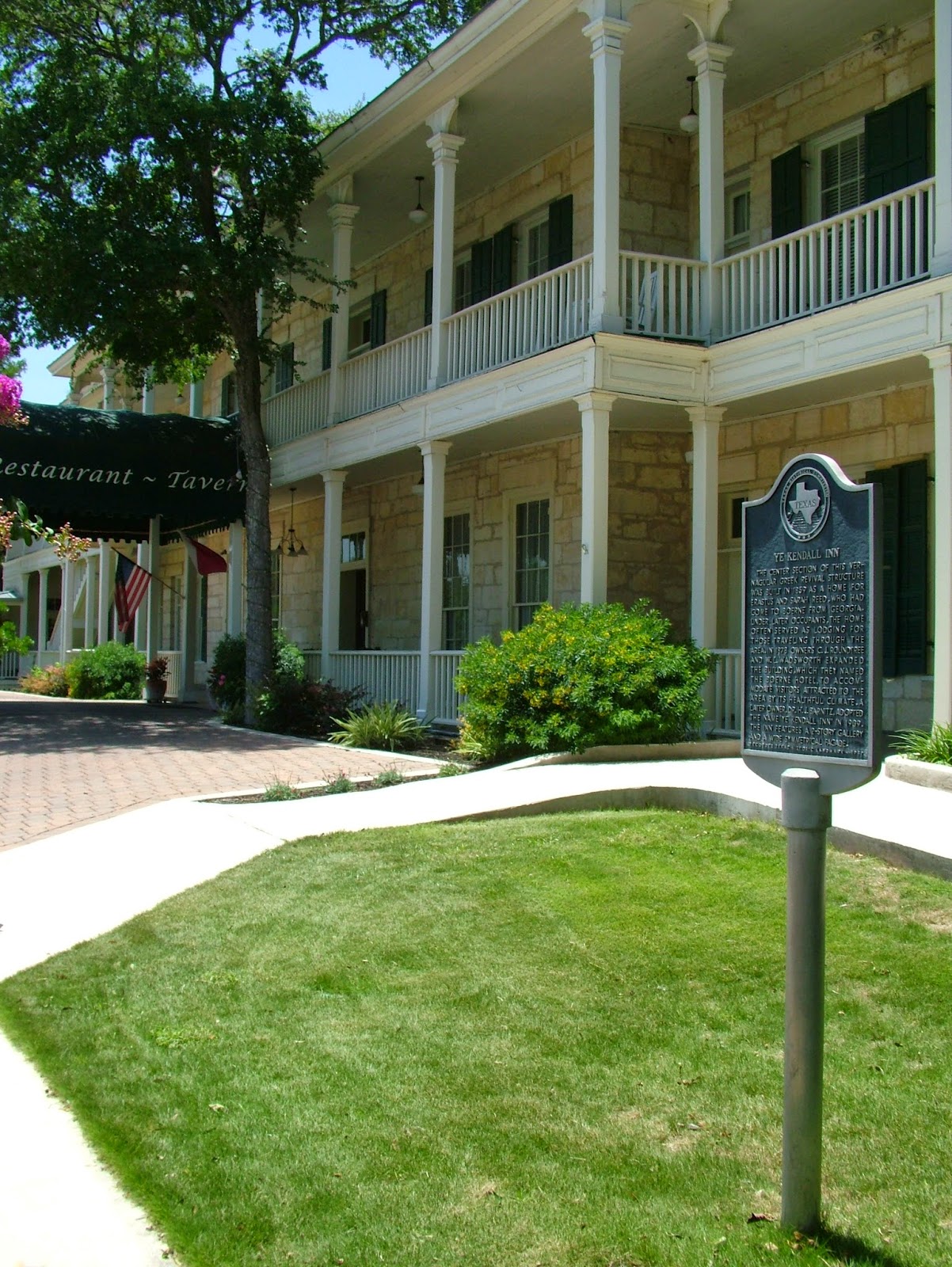
That is an excerpt from the chapter on Ye Kendall Inn that I wrote for Ghosthunting San Antonio, Austin, and Texas Hill Country! Above, a view toward the front of the inn, with a Texas state historic marker in the foreground; below left, a glimpse at some of the more than a dozen historic cabins and cottages that are available to guests at the inn; below right, a rare picture of me in the field, to include my bag of investigative equipment. 


Wednesday, November 26, 2014

University of Texas Tower (Downtown Austin)

"Visitors to the Main Building clock tower on the University of Texas campus in Austin who know nothing of its history might well wonder why it has security on par with that of a regional airport. People wishing to enter the tower must do so as part of an organized tour and are cautioned that after doing so they cannot leave before it is over. The hallway leading to the tower elevators is guarded by two armed police officers and a metal detector, and before going through it purses, backpacks, and the like must be checked with tour staff. When visitors exit the elevator on the 27th floor they will see yet another policeman and, when they walk up to the 30th floor and the observation deck, discover yet another one on duty there. The open areas of the observation deck itself is completely enclosed in metal caging with spaces just wide enough to slip a camera through. What is perhaps just as interesting as these stringent measures is that absolutely no reference to them is made at any point during the 50-minute tour. They are based, however, on terrible events that have occurred at the 307-foot-tall tower since it was completed in 1937 and these, and possibly the spirits of the disturbed individuals who perpetrated them, haunt the UT campus to this day." 

That is the opening paragraph to my chapter on the University of Texas Tower in Austin! I actually included a chapter on this infamous structure in my Texas Confidential: Sex, Scandal, Murder, and Mayhem in the Lone Star State. Below left, an image of the building taken around 1980 by photographer Larry D. Moore; below center, Charles Joseph Whitman, who used the tower as the platform for a bloody rampage; below right, a view of the tower's observation deck as it appears today. 


Wednesday, October 1, 2014

Varhola Appearance on 'Pairanormal'

Very much enjoyed my appearance on the Pairanormal show when it returned to the air on Friday, September 26 on TMV Cafe! Had a great time when I was a guest on the show a couple of years ago and think everyone will enjoy my discussion with E.W. Bradfute and his co-host as we explored haunted places throughout the Lone Star State. You can check it our in archive now! 

Thursday, September 11, 2014

Faust Hotel (New Braunfels)

"In the western literary and occult traditions the name 'Faust' has an ominous connotation, and many people assume that the historic hotel in New Braunfels bearing this moniker received it as a tribute to the paranormal activity associated with the site. It is, however, named for its founder, flesh-and-blood local businessman Walter Faust Sr., rather than a figure out of German legend. 

Over the past few decades, the Faust Hotel has increasingly gained a widespread reputation for being haunted and has attracted the attention of various paranormal investigative groups. I have visited the hotel a number of times since 2009 and, among other things, have spent the night at it and conducted investigations on or around Halloween twice and appeared as a guest on the PSI-FI Radio show from it. It has, in fact, become one of my favorite sites in the Greater San Antonio area, not just for the strange things associated with it but also for its colorful history." 

Those are the opening words of my chapter on the haunted Faust Hotel for Ghosthunting San Antonio, Austin, and Texas Hill Country! I have investigated it a number of times and even appeared on the Psi-Fi Para Radio show from it and it is one of my favorite sites in the area. Above right is the lobby of the Faust Hotel as it appears today, below left is a historic image of the hotel as it appeared shortly after it opened in October 1929, and below right is developer Walter Faust Sr. 
 

Sunday, September 7, 2014

Gruene Historic District (Comal County)

"Anyone who has visited the historic village of Gruene on any given Saturday or any evening in the summer, when it is thronged with tourists and local revelers alike, might be surprised to learn that it was once a genuine ghost town. Gruene was, however, virtually abandoned for more than two decades, from around 1950 until the early 1970s, when it was restored as a tourist attraction, and today it is a district within the city of New Braunfels. While the living have returned, however, the ghosts of former residents have nonetheless remained ... "

Those are the opening words to my chapter on the Gruene Historic District of New Braunfels for Ghosthunting San Antonio, Austin, and Texas Hill Country! Two of the reputedly haunted place in the village are the Gruene Mansion Inn bed-and-breakfast and the Adobe Verde restaurant (below and bottom, respectively). It is also the home of Gruene Hall, the oldest continuously-operated dance hall in Texas! 


Tuesday, August 12, 2014

Beyond Texas: An Aegean Ghost Hunt (Santorini, Greece)

Anyone following this blog might well wonder why I posted to it 10 times in July but not at all in August! The answer is that I took a break from working on this book and spent four weeks making an "Aegean Odyssey" across several Greek islands, in part to do research for a number of projects for Skirmisher Publishing LLC (anyone interested in seeing daily reports of this trip can check them out at my TravelBlogue). 

In the course of this trip I did take the opportunity to do a number of things related to my interest in paranormal investigation, to include studying grave stele and other items associated with graveyards at the various antiquities museums I visited. On the night of August 12, I also ventured out to a small cemetery located near the northeastern edge of the town of Fira on the island of Santorini and, over the course of a couple of hours, conducted a brief investigation of it and took about 220 digital photographs. 

This site was a walled compound that contained two large chapels, a number of mausoleums, and probably fewer than a hundred individual graves. It is probably a private cemetery, appeared to be affiliated with the Greek Orthodox faith, and reflected a certain level of affluence. The gate to the cemetery was not locked and, as always, I showed proper respect for the people interred there and their families and observed appropriate spiritual precautions. 


Above left, a structure that might be a smaller chapel, a mausoleum, or both; above center, a view down one of the few relatively long pathways in the cemetery  compare with the image of the same place at bottom, which has a gray mass of some sort in it; above right, the main chapel at the north end of the cemetery, built in a classic Byzantine style. 


Above left, a fairly significant orb can be seen toward the left side of this image; above right, this gravesite has one of the lamps that can be seen burning at night. 

One thing that can make Greek burial grounds feel kind of creepy is the practice of keeping lamps or candles burning at many of the gravesites (something that indicates ongoing care and, once again, the financial means for doing so). 

Suffice it to say that the Fira cemetery felt very active to me and that I caught what seemed like a disproportionately high level of anomalies in my photographs. Foremost among these is a virtual cloud of orbs in one of the first shots I took, of one of the two chapels from the roof of an adjoining building (top right); my first assumption is that I was seeing some sort of atmospheric effect but this was belied by the fact that no anomalies appeared in any of the other images of the chapel that I took in a series over a five-minute period (the one of the same thing that appears at the right end of the top row of pictures was taken about a minute earlier). I also picked up individual or pairs of orbs in a number of shots and what may have been a vague gray mass in one (at the center of the image at bottom). There was also one place where I felt very apprehensive about photographing some vaults flush with the ground and opted not to do so  irrational, perhaps, but you have to go with your intuition when conducting an investigation and it is better to be safe than sorry! 

  
Above left, a fairly profound orb appears at the far left side of this image; above right, I was able to see inside of this vaulted mausoleum but did not see anything exceptional in it. 

Above left, this image gives a good sense for the subtropical climate of Santorini, one of the Cycladic Islands of Greece; above right, the second large chapel in the cemetery has a vaulted style that is popular for many sorts of buildings throughout Greece, especially in rural areas; bottom, what appears to be a gray mass that might or might not be indicative of anything appears at the center of this image.